


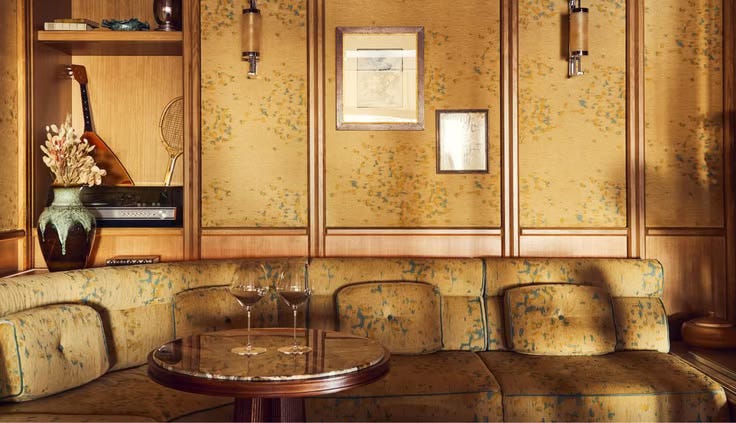
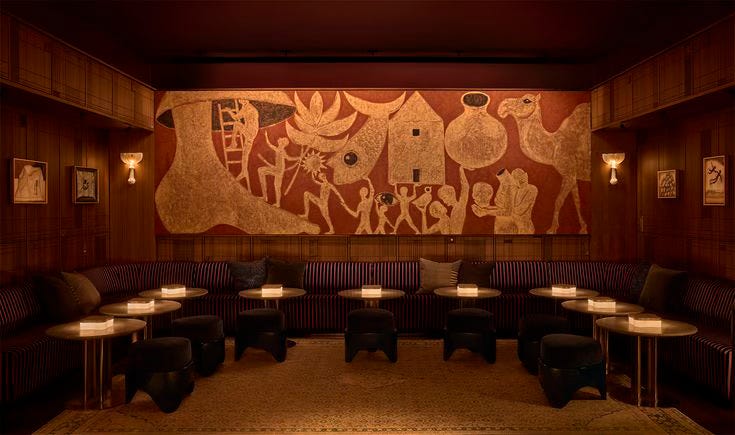
Walk into a hotel, members club, or bar that has opened in a major city in the last ten years, and you’ll find the space is color-drenched in saturated, muted tones like chocolate, oxblood, smoke, moss, ochre. The upholstery inside is substantive: boucle, mohair, velvet, thick enough to float you safely across the Hudson with Captain Sully. The light is low, the art is big and original, or looks original. The music volume sits just right, below conversation.
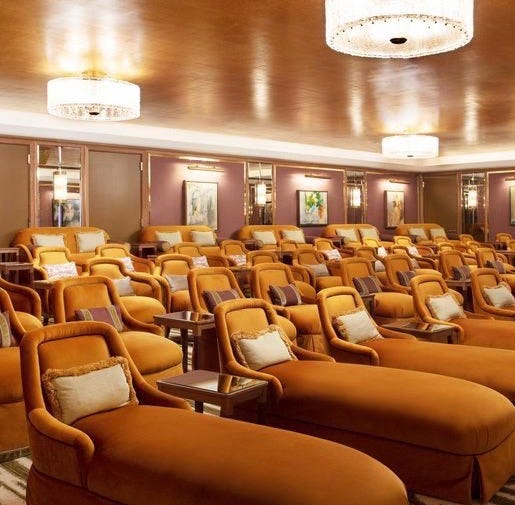
This is the look and feel of the 2020s. Enveloping, soft, spacious, secure, warm, rich, very here for you. The Upholstered Decade. I name it for the material because the material beautifully conveys what we seek from our spaces: big. cocoon. energy.
We love to wrap every interior surface a body might brush against in something soft enough to absorb discomfort of any kind. In this era, even a solid wall is clad — in warm wood, or better yet, suede.

The Upholstered Decade is the first design movement in centuries that is not a proxy for self-image. Every prior era was in conversation with a self-image. This one is in conversation with the body, more specifically the nervous system (as last week’s essay argued).
Here’s what every major design era before us was doing.
An abridged version:
Neoclassicism communicated authority. The post-revolutionary West needed its new governments, its new banks, and its new museums to look like they would preserve trust and guard assets. Columns and pediments were a civic argument that a hierarchy of power was now in place, and that the new orders deserved gravity. The British Museum, the Bank of England, the U.S. Capitol — each one asking its citizens, will you treat this republic with the seriousness it requires to prosper?

Art Deco in turn communicated prosperity. The 1920s had won, and all that winning needed a visual language. Polished steel, lacquered black, gilded edges, exotic woods. The brag of a class and a continent that had built sophisticated machines and invented speed. The Chrysler Building, Rockefeller Center, the Queen Mary’s first-class smoking room — each one asking the visitor, can you meet the sophistication of this much excellence?

Then the Depression came, and the war after it, and decorative arts and embellishment started to look obscene.
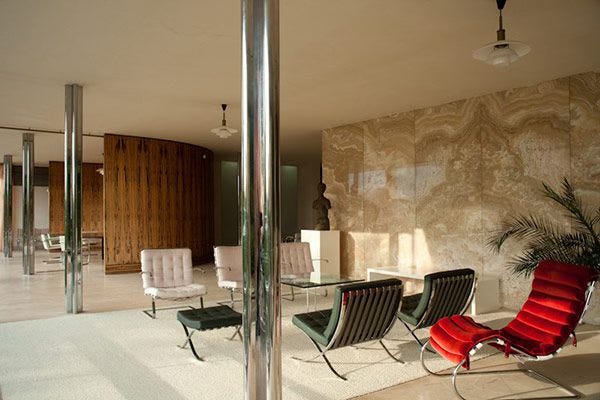
Modernism replaced ornament with utilitarian silhouette. The Bauhaus and the International Style taught a generation that the outline of the form was the design, and ornament was almost gauche. Discerning strong from weak composition became the measure of personal taste. Pragmatism was moralized. The empty wall was proof you were confident enough to be informed, unsentimental, and possessed of taste. The Barcelona chair, the Tugendhat House, the Farnsworth — each one asking, are you stoic enough to live without flourish?
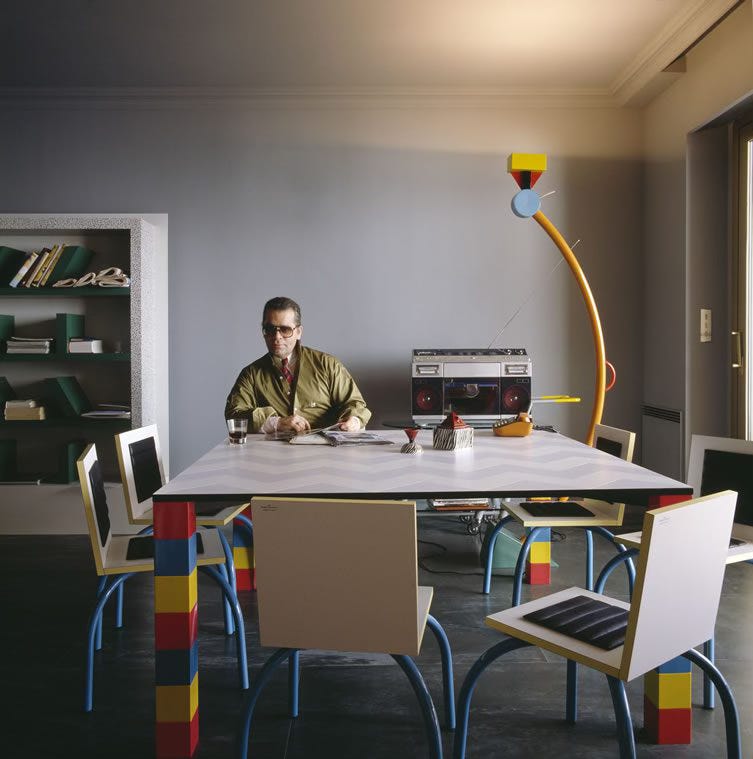
Postmodernism reintroduced reference. The Modernists had deprived us of irreverence, and within a generation we were back to being silly. Zanini, Sottsass and the Memphis Group, Gehry's Bilbao — the educated mind playing with itself in public. In the 1980s, Karl Lagerfeld famously committed to the bit for an apartment he owned in Monte Carlo. This era asked, do you get it?
Kinfolk was almost a theatrical renunciation. By the early 2010s the creative class had decided the appropriate response to digital saturation was to pretend it could be opted out of, and the aesthetic was a cosplay of restraint and maturity — like someone just back from CDMX for the first time. The spartan shelves with one farm-to-table cook book and a hand-thrown ceramic that sparked joy.

In this era, everything was whittled down to almost Amish proportions in order to demonstrate that we savored life’s simple things. We were asked, are you mature enough to keep less and remain nourished? For me it felt like the last decade we believed we had an answer to absolutely anything.
Each of these eras was a faithful expression of what its moment valued, feared, and aspired to. The committed republican. The polished arriviste. The disciplined modern. The educated ironist. The mature renouncer. Design was always asking who you wanted to be, or wanted to say you were.
The Upholstered Decade just needs you to show up.
Notice what the deeply plush, burgundy room does not ask. It does not ask you to be a serious citizen, a successful one, a moral one, a smart one, a wise one. The room demands nothing of the person inside it. It works on you while you sit in it, just so you can exist in it long enough to be a paying customer.
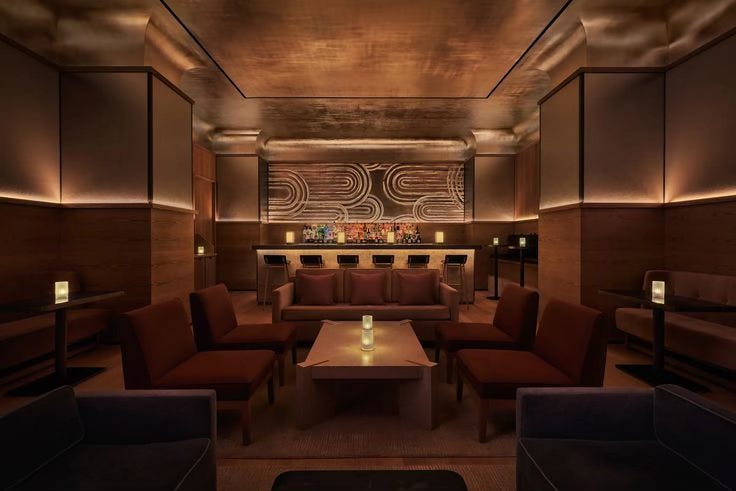
The deep upholstery absorbs sound. The mohair absorbs light. The color drench eliminates the visual contrast that keeps the eye scanning. Exhale. Stay long enough to consider ordering martini service.
You cannot argue a body into relaxing. You cannot lecture a nervous system into settlement. You can only build a room that does some of that work for the guest, rewarding them for leaving their house. We spend more freely when we are relaxed, when our grip on time has loosened. The economics of upholstery are also somatic.
Commitment.
All of these designers share the same instinct: to build a room so committed to its own universe that body state has nowhere to go but with it. The formula varies — color drenching, tonal color fields, cinematic lighting schemes, and ceilings designed as richly as floors. The end effect is suspension of disbelief. You surrender—I want a cigarette, I don't even smoke.
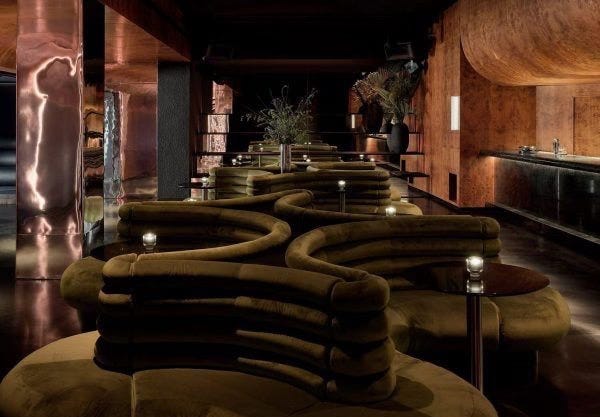
Anywhere a body has to spend time will eventually be redesigned around a single question. What does my nervous system need in order to inhabit, without strain, whoever I have come here to be? That is the question every era before us was too busy with self-image to ask.
Yes — selecting your environment is still a self-image act. But in this decade, the spaces that get chosen have more than image to deliver.
I notice this in my own body now, in a way I did not when I started writing about it. I used to walk into a beautifully designed restaurant and assess its every detail. The layout, the tiles, the lighting choices, the chairs. I google the designer...
Now the first thing I notice is how quickly I’m able to unhinge. I ask myself, “Can I truly unravel here in leisure with not one, but two martinis?” When the environment is somatically comfortable, the vibes come on fast. And if it is not that, I would rather be home. Only after I have decided I am at ease, can we discuss the glassware.
I am not the only person making this distinction. We are all doing it. But we will say a place feels good. We say we like the vibe. We say we would definitely go back.